Robotic Surgery
Robotic & Minimally Invasive Surgery
Precision thoracic and foregut surgery through small incisions — with magnified 3D vision, tremor-free instruments and a multidisciplinary plan built around the patient.
Designed for
Patients & families
Format
Interactive, visual
Next step
Consult & plan
Quick overview
Small incisions, magnified view and fine instrument control — while keeping safety and cancer clearance as the priority.
Pre-op planning
Scans + staging + team discussion
Precision steps
3D view + wristed instruments
Recovery pathway
Early mobilisation + guided follow-up
Robotic & Minimally Invasive Thoracic Surgery
Precision surgery through small incisions
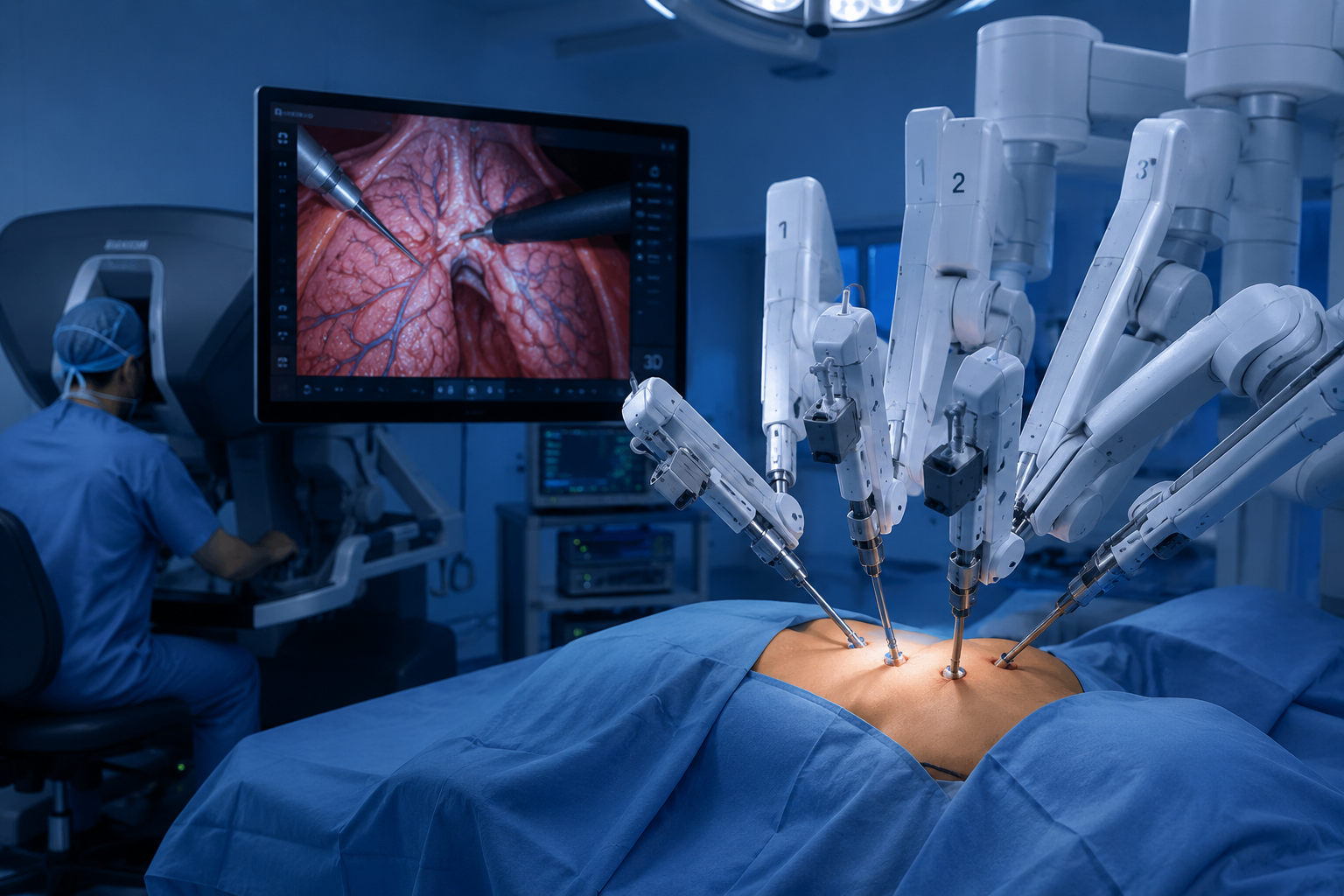
Robotic and video-assisted (VATS) techniques allow complex thoracic and foregut procedures to be performed through small cuts, with magnified 3D vision and fine control of instruments. These approaches complement sound surgical judgment and multidisciplinary decision-making.
Robotic platform
See it in motion
Precision, Demonstrated
The robotic system doesn't simply mirror the surgeon's hand — it refines it. Move your cursor across the left panel (or drag with your finger on mobile) and watch the instrument tip on the right respond with motion scaling and tremor filtration in real time.
Console-side
Surgeon's Hand
Move your cursor here →
Patient-side
Instrument Tip
Scaled · Filtered
Hand speed
0 mm/s
Tip speed
0 mm/s
Tremor amplitude
0.0 mm
Active scaling
2.5 : 1
Motion Scaling
Large, comfortable hand movements at the console are translated into much smaller, more precise instrument movements inside the chest.
Tremor Filtration
High-frequency hand tremor — present in even the steadiest surgeons — is filtered out in real time before reaching the instrument.
7 Degrees of Freedom
Wristed instrument tips bend and rotate like a human wrist — well beyond the range of straight thoracoscopic tools.
An interactive atlas
Procedures, Mapped to Anatomy
Tap an organ — or pick a procedure below — to see the robotic approach, port placement on the chest or upper abdomen, recovery profile, and the structures we work hardest to preserve.
Anatomy
Front view
Tap any highlighted organ to see the related procedure.
Potential benefits
- Smaller incisions and reduced muscle cutting.
- Magnified 3D view of critical structures.
- Fine movements with wristed instruments.
- Possibility of less pain and quicker mobilisation.
- Shorter hospital stay in appropriate cases.
Important considerations
- Not every patient or tumour is suitable for robotic / VATS approaches.
- Safety and oncologic completeness take priority over incision size.
- Complex cases may still require conventional open approaches.
- Final decisions follow scan review + lung function + overall health.
Next step
Need help deciding?
Share your reports and scans. We'll explain options in simple terms and plan safely.